Monday, September 17, 2018

When History and the Present Collide

The cross-country road trip with my son this past June was a lot of things: long stretches of highway, late-night hotel check-ins, and a mutual discovery of roadside diners. For both of us, it was also a pilgrimage through history, adding another chapter to our long list of battlefield and museum visits. We walked the grounds of Little Bighorn, stopped at Mount Rushmore, and spent a genuinely odd morning at the Circus World Museum in Baraboo, Wisconsin. On June 12, we found ourselves on a quiet ridge in Maryland, standing over the ground where America nearly broke in two.

Ted was a year out of college, getting ready to move to New York and begin his new career. I was in full dad mode: proud, a little anxious, acutely aware that this kind of trip wouldn’t come around again easily. For me, there’s something about being at a Civil War battlefield with one or more of my kids that makes the distance between 1862 and right now feel very small.

Standing on Sacred Ground

Burnside's Bridge - 2018

September 17, 1862, remains the single bloodiest day in American military history. More than 23,000 men fell in twelve hours, more casualties than America suffered on D-Day. The numbers are hard to hold in your head when you’re standing on grass that looks like any other grass, under a sky that looks like any other sky.

We made two stops that demanded longer than the others.

The first was Burnside’s Bridge, known at the time as Rohrbach Bridge. It’s a low stone span, twelve feet wide, with three graceful arches, built in 1836. Twelve feet. Standing on it, you can touch both walls without fully extending your arms. For hours that September morning, a small force of Georgian sharpshooters held it against repeated Union assaults, picking men off as they funneled onto the bridge. When the 51st New York and 51st Pennsylvania finally charged across in the afternoon, they paid for every inch. The bridge is beautiful now, quiet, a little mossy, the creek running below it exactly as it did that day. It’s easy to forget what it cost.

Bloody Lane - 2018
The second stop was Bloody Lane. What had been a sunken farm road became a Confederate defensive position, and then a killing ground when flanking movements collapsed the line. The men who died there were close to Ted’s age, many of them far from home, fighting their first and last battle on the same day.

Gardner's photo of Union troops inspecting piles of
Confederate bodies at Antietam's “Bloody Lane.”
 
Walking that lane in the June heat, I kept thinking about Alexander Gardner’s photographs taken here in the battle’s aftermath. His images of the corpse-strewn road went on display in Manhattan weeks later and drew enormous crowds. For the first time, ordinary Americans could see what the war actually looked like: not paintings, not illustrations, but photographs of real men who had been alive that morning. It shattered any romantic notion of battle as something glorious. Ted and I walked the lane quietly, not saying much. Sometimes you don’t need to.

The Divided Present


It’s hard to stand on a Civil War battlefield in October 2018 without feeling the pull of certain parallels. We’re weeks from a midterm election that feels, to a lot of people, like something more than a normal election. The political conversation this fall has been defined by what feels like irreconcilable differences: fierce debates over immigration, a public discourse that leaves little room for nuance, and a sense that we’re not just arguing about policy anymore but about who gets to define the country.

The Confederate invasion of Maryland was timed deliberately to fracture Northern resolve before the 1862 midterms, a calculated attempt to swing Congress toward a negotiated peace. Reading Justin Martin’s account of that strategy over the past few months, the echo is hard to miss. Much of our current political rhetoric feels built the same way: designed to mobilize through fear rather than appeal to anything shared.

The polling this fall describes a nation more polarized than at any time since the Civil War era. We’re not just disagreeing about tax policy or healthcare. We no longer seem to agree on basic facts. Lincoln observed that a house divided against itself cannot stand. Standing on the ground where that division nearly became permanent, it’s hard not to wonder how much strain a house can take before the framing gives.

Gardner’s photographs shattered illusions about warfare in 1862. What shatters illusions now is social media and round-the-clock news, doing something similar to our politics: stripping away the comfortable distance between what we’d like to believe and what’s actually happening. Gardner’s photographs were meant to show the truth. I’m not always sure what our current media environment is meant to do.

The Continuing Work


Lincoln spoke at Gettysburg about “the unfinished work” that each generation must take up. The soldiers at Antietam didn’t choose the moment history handed them. They had no idea whether dying in a Maryland cornfield would change anything. They couldn’t see past the smoke and noise to whatever came next. They just kept going.

Whatever happens in November, I suspect we’ll end up in roughly the same place Antietam left the country in 1862: somebody will claim victory, and then the harder, slower work of actually governing together will resume, no matter who ends up with more seats in Congress. That work isn’t glamorous. It doesn’t have a monument. But it’s the work that keeps the house standing.

Ted has settled into his new life in New York now, and I find myself thinking about what his generation is inheriting. The summer road trip, the quiet walk down Bloody Lane, the bridge that cost so much to cross. Those things stay with you. I hope they stay with him.

The conversation between the past and the present keeps going. So does the unfinished work. Standing on that Maryland battlefield with my son, I had every reason to believe his generation will be up to it.

Wednesday, June 6, 2018

Castles in the Clouds (Now with Structural Integrity)

Over the past seven years, I’ve had the honor and, let’s be honest, occasional heartburn of watching each of my kids graduate from high school and make their way to college. And just this spring, I watched my youngest cross that stage, diploma in hand, looking ahead to college and new opportunities to perform on stage. Not long ago, I stood in similar crowds as both my oldest daughter and my son graduated from college in 2015 and 2017, respectively. My oldest is now in medical school, and my son is just beginning his professional journey. Five graduations in seven years. One by one, they’ve crossed stages and thresholds, each carrying their own hopes, anxieties, and a slightly wrinkled gown—we definitely didn’t press well enough.

And with each of them, I found myself standing at the edge of something too part pride, part panic, and part wondering: What now?

Not just for them, but for me.

Because no one tells you that watching your kids leave the nest doesn’t just mean you’ve finished building their launchpad, it means you’re suddenly staring at a big stretch of sky and wondering if it might be your turn again.

That’s where Thoreau comes in:

If you have built castles in the air, your work need not be lost; that is where they should be. Now put the foundations under them.

I love that quote. It sounds dreamy at first, but dig deeper, and it's rock solid. Dream big. But then get to work. And not just once when you're young and fearless, but again and again as your dreams evolve. My mom actually gave me a card with that quote when I graduated from high school. At the time, I probably didn’t grasp the full weight of it, too distracted by tassels and the vague smell of barbecue from the grad party, but it stuck with me. Decades later, I see how right she was to press that wisdom into my hands. It’s not just advice. It’s a blueprint. One, I’ve watched my kids begin to follow in their own way, and one, I’m finally coming back to myself.

It reminds me, too, of a softer take from Little Women:

Wouldn’t it be fun if all the castles in the air which we make could come true, and we could live in them?

There’s something tender and hopeful in that. Because, of course, dreams can come true, but not by accident. They’re built slowly, intentionally, with more elbow grease than fairy dust. That’s what I’ve tried to teach my kids. And what I’m still learning myself.

Watching my kids head off into the world reminded me that dreaming isn’t a phase; it’s a practice. And while they’ve been sketching out the first spires of their castles, I’ve been quietly digging up some blueprints of my own, the ones I tucked away years ago under a pile of permission slips, grocery lists, and sports schedules. Dreams don't expire, it turns out. They just wait for quieter mornings.

Still, this post isn’t just about me dusting off old ambitions. It’s also a note to my kids and anyone else standing on the edge of graduation, or reinvention, or just the next big thing.

If I could give you one more speech (the kind you don’t have to sit through in a folding chair), I’d borrow heavily from Paul Graham’s brilliant essay, What You’ll Wish You’d Known. It’s the kind of advice that skips the clichés and gets to the good stuff. So here goes:

1. You don’t have to know what you want to be.

Seriously. You’re not behind if you don’t have a 10-year plan. Let curiosity lead for a while. Try things. Follow what fascinates you. Most people don’t find their path; they stumble into it while doing something else.

2. Work hard at things that feel fun to work hard at.

This is the secret sauce. Don’t chase status. Chase flow. If you find yourself losing track of time while building something, learning something, or fixing something, that’s a clue.

3. Don’t be afraid to be bad at something.

The early stages of any good project, whether it's a podcast, a physics degree, or a life, are messy. Ugly, even. You have to wade through awkward to get to awesome.

4. Pay attention to the things that bother you.

What frustrates you about the world? What would you change? That’s often where your purpose lives. Don’t be afraid to ask, “Why is it like this?” and then go fix it.

5. You’re not locked in.

Change your major. Change your mind. Change your definition of success. Anyone who tells you that you have to pick a lane at 18 probably sells traffic cones for a living.

And to my kids, specifically, thank you. For letting me walk alongside you as you started your own builds. For teaching me that dreams are not a one-time event, but a renewable resource.

Because watching you chase your castles has reminded me: I’ve got some unfinished architecture of my own. And now, with a little more time and a lot more perspective, I’m putting those foundations in.

So wherever you are, clouds, sky, or air keep building. Keep learning. Keep asking better questions. And don’t worry if the blueprint changes along the way.

Oh, and come home sometimes. I’ve got snacks.

Sunday, October 15, 2017

The Imperial Cruise (REVIEW)

The Imperial Cruise: A Secret History of Empire and War 

by James Bradley


My rating: 1 of 5 stars

Some lessons arrive early and stay with you for the rest of your reading life. Mine came from a professor named Keith Nelson, who taught history at the University of California and co-authored a slim but formidable book called Why War? Ideology, Theory, and History with Spencer C. Olin. The book came out in 1979, and it did something most undergraduate courses never bother with: it taught me to read the historian before I read the history.

Nelson and Olin’s argument is easy to state, but it changes everything once you’ve absorbed it. Historians aren’t neutral. They carry ideologies: conservative, liberal, or radical. Those ideologies generate theories, and those theories determine which questions get asked, which evidence gets elevated, and which conclusions feel inevitable before a word has been written. Most historians aren’t fully conscious of this. The ones who are rarely admit it. Dr. Nelson taught me to find it anyway: to look past the argument being made and ask what the author had to believe before they could make it.

I thought about Dr. Nelson a lot while reading James Bradley’s The Imperial Cruise: A Secret History of Empire and War.

---

What Bradley wrote instead is a verdict in search of a trial.

As an undergraduate at UC Irvine in the late 1980s, Dr. Nelson taught me to do one thing before anything else: identify the ideological framework an author brings to the evidence, because that framework will determine everything that follows. Applied to The Imperial Cruise, that framework surfaces almost immediately. The villains are not simply flawed men making consequential decisions. They are the American ruling class, driven by a racial supremacist ideology, wielding state power in service of imperial ambition. That framing is recognizably Marxian: a dominant class, an ideological superstructure that justifies its dominance, a state apparatus that does its bidding. Bradley never uses that vocabulary. He doesn’t have to. The structure of his argument carries it.

That habit — reading the historian before reading the history — was also what drove me to the scholarly literature once I finished the book. Something felt wrong with Bradley’s method, not just his conclusions, and I wanted to see how trained historians had received it. I wasn’t surprised by what I found.

The tell is his use of the word “Aryan.” He applies it relentlessly and strategically, building a case that Roosevelt and the political elite around him were not merely products of their era’s racial attitudes. They were architects of a white supremacist project. And here is where the book crosses from argument into manipulation: Bradley deploys “Aryan” with the deliberate intent of drawing a through-line between turn-of-the-century American imperialism and Nazi Germany. Historian William Tilchin, writing in the Theodore Roosevelt Association Journal, identified the tactic directly, calling Bradley’s constant use of “American Aryan” obviously designed to suggest that historical American racism was on par with Nazism (Tilchin 39). Jonathan Tobin, writing in Commentary, described the book as representing a new and especially low chapter in ideological American historiography (Tobin 26).

None of this means the underlying history is false. American imperialism in the Philippines was, at times, brutal. The death toll from the Filipino-American War runs into the hundreds of thousands. Roosevelt’s racial views shaped his diplomacy in ways that deserve serious examination. The question isn’t whether the grievances are real. The question is whether the analysis is honest. And that’s where Nelson & Olin’s framework cuts deepest: when an ideology drives the evidence rather than the other way around, even legitimate grievances get buried under the weight of a predetermined conclusion.

---

The most troubling part of the book is how Bradley uses his primary sources.

There’s a specific problem any careful reader will notice: the blurring of source and interpretation. Primary source material flows into Bradley’s own voice without clear demarcation. You find yourself reading what you believe is a direct quotation from Roosevelt or a period document, and then you realize — sometimes pages later — that you’ve been reading Bradley’s characterization all along, with no signal that the transition happened.

Tilchin documented this at the mechanical level. Quotations end without being marked as ending. In one full chapter, more than twenty-five consecutive endnotes don’t correspond to the note numbers they’re linked to. In one instance, Bradley invokes “one historian” to support a significant claim, names no one, and provides no citation.

That last example is worth sitting with. Attributing an argument to an unnamed historian isn’t an oversight. It’s a rhetorical device. It asserts the authority of scholarly consensus while deliberately withholding the evidence that would allow a reader to evaluate it. Dr. Nelson would have recognized that move immediately. It’s exactly the kind of covert theoretical operation his book was designed to expose.

Bradley’s most sweeping claims, including the Aryan argument at the book’s center, are made with almost no direct quotation at all. The evidentiary weight rests on assertion and framing, not documentation.

---

What makes all of this more significant is that the pattern doesn’t start with The Imperial Cruise.

Bradley’s first book, Flags of Our Fathers, built its entire emotional and commercial foundation on a personal narrative: his father was one of the men who raised the flag on Iwo Jima in the iconic 1945 photograph. The book became a bestseller and was adapted into a Clint Eastwood film. In 2016, the Marine Corps completed an investigation confirming that John Bradley was not in the famous photograph. He had raised an earlier, smaller flag. The man in the iconic image was someone else entirely. You can extend Bradley the grace of noting that this was a pre-existing historical misidentification, not something he fabricated. But the kind of rigorous primary-source research Flags of Our Fathers claimed to represent might have found the discrepancy before it became the foundational premise of a bestselling book.

His follow-up, Flyboys, drew pointed criticism from Naval History Magazine, which found it riddled with errors and offered a concise description of Bradley’s research method: his technique, the reviewer wrote, seems to have been to find the most startling book on a subject, then borrow heavily from it. Find the most dramatic source. Borrow heavily. Assert confidently. That’s the throughline across all three books, and it reaches its most developed form in The Imperial Cruise.

---

Here’s what I keep coming back to.

Nelson and Olin weren’t arguing that ideological historians are bad historians. They were arguing that hidden ideology is dangerous because it can’t be evaluated, challenged, or corrected. A scholar who argues openly from a radical framework does something intellectually honest: here is my premise, here is my theory, now test it against the evidence. Even when you disagree with the conclusion. What Bradley does is different. He presents polemic as investigation. He frames advocacy as discovery. He gives you a book that looks like history and reads like a closing argument.

The frustrating part is that the real history underneath it matters. The Taft-Katsura Memorandum deserves more attention than it gets. The American imperial project in the Philippines deserves reexamination. Roosevelt’s racial worldview and its diplomatic consequences deserve serious scrutiny. These are not invented grievances. They’re the foundation of a book worth writing.

Bradley chose to write a different book. One where the verdict came first, and the evidence was arranged around it.

Dr. Nelson taught me to recognize that move. I was twenty-two years old at the time, and I’ve never stopped using it.

View all my book reviews.

---

Works Cited

Bradley, James. The Imperial Cruise: A Secret History of Empire and War. Little, Brown and Company, 2009.

Nelson, Keith L., and Spencer C. Olin. Why War? Ideology, Theory, and History. University of California Press, 1979.

Tilchin, William N. “James Bradley’s ‘The Imperial Cruise’ is an Outrage, Pure and Simple.” Theodore Roosevelt Association Journal, vol. XXXI, no. 4, Fall 2010, pp. 39-45.

Tobin, Jonathan S. “Smearing Theodore Roosevelt.” Commentary, March 2010, pp. 26-29.


Wednesday, September 27, 2017

To Dream Impossible Dreams

My sophomore year of high school, I saw two musicals in the same year. The first was A Chorus Line, on a double date with friends. The second was Man of La Mancha.

Man of La Mancha is the one that stuck.

I came by my love of the form honestly. My mom was a theater kid, in high school and in college, and she made sure my brother, sisters, and I were exposed to the art form whether we asked for it or not. My dad was considerably less enthusiastic about the genre, which meant taking us to see shows fell almost entirely to her. I never wanted to be on stage myself (despite a turn as Otto Frank in an eighth-grade production of The Diary of Anne Frank), but in high school I worked crew — sets, lights, props. Our school put on Godspell my junior year, and I spent more evenings than I can count in that theater without ever saying a word from the stage. I didn't mind. Something about being in the building when a show comes together suits me better than the spotlight.

In college, I took a history of musical theater course to fulfill a humanities breadth requirement. The kind of course you sign up for because you need the credit and stay for because it turns out to be the best class of the semester. It connected my love of history to something I'd always enjoyed without being able to say why. Musicals, at their best, are documents. They tell you what a culture was worried about, what it needed to believe, what it wanted to hear sung back to it.

I never lost the thread. Man of La Mancha has been with me since that sophomore year. My mom put me in that theater. I don't know if she understood what she was handing me — probably she just loved musicals and wanted her son to love them too. But something about Don Quixote settled into me at fifteen and shaped how I've looked at things ever since. The willingness to see what you choose to see. The refusal to stop before you're finished.

Which is why, forty-some years later, I took Faith to Pasadena on a Saturday afternoon. And why I wrote the check for the summer program. You can't give a kid what a single experience gave you. You can only open the door and hope the right thing is waiting on the other side.

A Noise Within, on Foothill Boulevard in Pasadena, was running a production. It's a serious theater, a repertory company that takes classic texts seriously and draws audiences who come to be moved. Faith had been on stage in church Christmas pageants, high school productions, and at summer acting camps before, but this was different. This was the two of us, and a story I'd carried for forty years.

She loved it. This didn't surprise me.

Faith is a theater kid the way my mom was a theater kid — the way some people just are, from the beginning, without needing to be talked into it. She's done every school production available to her and made no secret of wanting to pursue acting professionally. As a freshman, she told her mother and me that college was probably unnecessary, since she planned to move to Hollywood and become an actor. We had many conversations (and therapy sessions) about that. She came around on college. She has not come around on acting.

What Man of La Mancha did that afternoon was confirm something she already knew about herself. I watched her watch the stage. I recognized the look.

A few weeks later we signed her up for Summer With Shakespeare, A Noise Within's youth acting program. Six weeks of real work: movement, language, stagecraft, the business of what professional actors actually do. Not drama club. Not a school showcase. She came home from each session exhausted and talking faster than usual.

Following the program, the theater held auditions for their fall season. One of the productions was A Tale of Two Cities. Faith auditioned. She got cast.

She plays a member of the mob. It's not a large role. But it is a professional one, in a real production at a theater that gets reviewed. The show runs through November. Her first professional credit.

A Noise Within ran a short interview with her on their website. She told them: "This is my first time in a professional production. I want to be an actress, and having the experience of working with Julia and Geoff [Elliott] and also with all the other super talented actors on stage is the very best part." She also said something I keep returning to: "If I had not participated in the education programs at ANW, I would never have had the chance to audition."

That sentence is the whole argument, as far as I'm concerned. You can't hand a kid a dream. What you can do is put them somewhere the dream becomes possible. You take them to see the show. You pay for the summer program. You drive them to auditions. Then you get out of the way while they figure out whether this is who they are.

Maybe she becomes an actress. Maybe she doesn't. What I know is that this fall she's standing on a professional stage for the first time, working alongside trained actors, learning what the work actually requires. She got there because a door opened, and she'd been given the tools to walk through it.

Don Quixote spends the whole play insisting the world is not what the world insists it is. The play doesn't ask you to agree with him. It asks what it costs to stop.

For today, I'm not going to be the one to tell her the windmill is a windmill.

You can read the interview A Noise Within did with Faith on their website. A Tale of Two Cities runs through November 19th. Go see it.

Editor's Note: In a more recent post, I wrote about how my mom's love of musical theater, my time on stage crew, and those years sharing shows with Faith all came together around a very different kind of theatrical tradition. You can read it here: Liberty in Three Acts.

Saturday, May 27, 2017

The Last Game

Last night, May 26, 2017. I'm sitting in my living room in La Crescenta, laptop open, watching a grainy live stream of the West Coast Conference tournament. Six hundred miles north in Stockton, my son Ted is warming up in the bullpen for what has just become the final game of his college baseball career. The Loyola Marymount Lions are facing elimination against BYU, and I was supposed to be driving up today for the championship game if they could pull this one out.

The Lions are down 5-1 in the seventh inning. It doesn't look good.

Then Ted gets the call.

Where It All Began

The journey to last night in Stockton began on a different field entirely, decades earlier, with a bucket of tennis balls and a toy wooden bat that looked enormous in four-year-old hands. I bought him his first glove and baseball the day he was born. I know that was more about me than it was about him. But before he was old enough for organized teams, we were out in the backyard, me pitching underhand, him swinging with all the ferocity a preschooler could muster.

That little boy who slept with his glove under his pillow became the kid who mimicked batting stances he saw on TV, who lived and breathed Cubs baseball like his dad. He had a quick bat and a sharp eye, even as a little kid. He didn't just play baseball; he loved it. He studied it. From the time he started in Tee Ball, I saw his competitive fire up close. He wanted to win, sure, but more than that, he wanted to be better. To do it right. To work harder. To be ready.

His first Little League hit was an RBI triple off Nate Rousey. I still remember that poor Nate cried afterward. His first home run came the next season. With each passing year, the instincts sharpened. The arm got stronger. The glove got quieter. The bat got louder. By the time he was a senior in high school at Crescenta Valley, he wasn't just a good player; he was a leader, a shortstop you built your infield around, a pitcher you trusted in big moments.

And then came that magical evening against Arcadia High four years ago. Two outs in the bottom of the seventh, the Pacific League title hanging in the balance. CV down 4-2. Ted stepped up to the plate and launched a three-run homer into the night to give us a 5-4 victory and the championship.

Crack.

That sound, you know the one. The sound that makes a stadium rise as one. The ball sailing high over the left-center-field fence. But this wasn't some major league park. This was a high school diamond where my son had just become a legend, where years of backyard practice and Little League dreams crystallized into one perfect swing.

The College Years: Learning to Let Go

When Ted committed to LMU, it felt like the natural next chapter. Division I baseball was his dream realized. But it also marked a profound transition for me: from the sidelines coach who knew every pitch and every at-bat to the distant observer, I was lucky that he was close by, so I could watch home games, and I went to as many away games as time and schedule permitted. I followed LMU's box scores online, and loved the chance to take him to dinner after games.

But college baseball is different. The talent gap narrows. The stakes feel higher. And parents have to step back, to trust the coaches, to let their kids figure it out on their own. The intense involvement of Little League and high school gives way to something more like faith. Faith that all those years of instruction, all those conversations about effort and attitude and what it means to be a teammate, have taken root.

For four years, I've watched from afar as Ted found his place on the team, from third base his freshman and sophomore years, and an injury that sidelined his junior year, then as a pitcher in his senior year. I watched while he learned what it meant to compete at the highest amateur level. There have been highs and lows, moments of brilliance and stretches of struggle. The typical arc of a college athlete learning that talent alone isn't enough, that consistency, mental toughness, and team-first thinking separate the good from the great.

Last Night

Which brings us to last night in Stockton, to that elimination game, to Ted jogging in from the bullpen with the season on the line.

Down 5-1 in the seventh, facing a BYU rally with runners on base, this was exactly the kind of pressure moment we'd talked about since he was little. Not the glory moments, not the home runs or the strikeouts that make highlight reels, but the quiet, crucial situations where everything you've learned gets distilled into execution.

He shuts down the scoring threat in the bottom of the seventh. It wasn't perfect, but it was good.

Then, he pitches an almost spotless eighth inning.

Watching from six hundred miles away on that grainy stream, I can feel something building. The Lions start scratching and clawing in the ninth, mounting a comeback that brings them to within one run. Tying run at third base, two outs... For a moment, I can see it all unfolding: the impossible rally, the championship game I'll drive to today, one more chance to see him pitch at this level.

But baseball doesn't always deliver the endings we script in our heads. The Lions fell short, 5-4. The comeback comes up just shy. Ted's college career ends not with a championship, but with 1⅔ innings of relief, one strikeout, no runs allowed, and a team given every chance to win.

It was a beautiful ending, even in defeat.

What I'm Realizing This Morning

I had hoped to see Ted play live one more time. To make that drive to Stockton again, for the third time in four years, for today's championship game, to sit in the familiar bleachers and watch my son take the mound in the biggest game of his college career. That's not in the cards.

But as I watched him walk off that field last night for the final time, something unexpected happened. Instead of disappointment, I felt overwhelming gratitude. Not sadness that it's over, but appreciation for what we've shared.

I don't need one more game. I have a lifetime of them.

I have those early backyard sessions with tennis balls and patient instruction. I have Little League memories of a gradual transformation from enthusiastic kid to serious ballplayer. I've coached him, watched him grow, seen him develop not just as a player but as a young man who understands what it means to be part of something bigger than himself.

He has high school glory, that championship-clinching homer that still gives me chills, the no-hitter against Loyola High earlier that spring, and the Pacific League MVP award. The moments when talent met opportunity and created magic.

And now I have this: watching him finish his competitive career with grace, professionalism, and the kind of performance that reminds me why I fell in love with this game in the first place. Two crucial innings when his team needed him most. No fanfare, no headlines, just a job well done when it mattered.

The Gift of the Last Game

The thing about being a baseball parent is that you spend so many years living for the next game, the next season, the next level. You mark time by tournament weekends and playoff runs. Your calendar revolves around practice schedules and game times. And then, suddenly, it's over.

What I'm learning this morning is that sometimes the endings we don't choose are more meaningful than the ones we plan. I thought I wanted one perfect final game, one last chance to see him pitch with everything on the line. Instead, I'm getting something better: the realization that Ted has become exactly what we hoped when he first picked up that toy wooden bat.

A player who can be counted on. One who can handle pressure. One who will leave everything on the field, whether the lights are bright or dim, whether the crowd is thousands or just a few parents and coaches watching a live stream. Someone who understands that how you finish matters as much as how you start.

Ted's baseball career has taught him about effort, teamwork, resilience, and what it means to be reliable when others are counting on you. It's taught me about patience, pride, letting go, and the beautiful complexity of watching your child pursue their dreams at the highest level they can reach.

What Remains

Now he's moving on to a career, to a life beyond the diamond. But somewhere in him will always be that four-year-old swinging the big wooden bat, that Little Leaguer crossing home plate after his first homer, that high schooler rounding the bases in triumph, that college pitcher walking off the mound after giving his team every chance to win.

And somewhere in me will always be the dad who got to watch it all unfold, one game at a time, one memory at a time, grateful for every single pitch.

Even the last one.

Especially the last one.

Because that's when I learned that the end of something beautiful isn't always sad. Sometimes it's just complete.

I'm grateful, too, that I was able to capture last night's game. That live stream, which I managed to grab, now holds Ted's final collegiate performance. Having it preserved means our family can revisit this moment, not just the statistics or the outcome, but the grace under pressure, the professionalism, the way he carried himself in those crucial innings. Years from now, when the details start to fade, we'll be able to watch again and remember not just what happened, but how it felt to witness the beautiful completion of a chapter we'd been writing together for over two decades.

Sometimes the most precious gifts come in the form of technology we take for granted until it captures something irreplaceable.

Friday, February 24, 2017

Searching for Mom's Meatloaf

There's a certain kind of recipe that lives only in memory, formless, undocumented, yet stubbornly persistent in taste and feeling. For me, it's Mom's meatloaf. The one she made when we were kids, back when Tuesday nights meant the smell of onions browning in her old cast-iron skillet would drift upstairs to where we were supposed to be doing homework. The one that would somehow taste even better the next day, straight from the fridge, nuked in the microwave until the edges got those perfect crispy bits, and served with some mixed vegetables and a helping of Del Monte canned pears (yes, with the heavy syrup because Mom believed dessert didn't always have to come last).

I can still see her in that kitchen, sleeves pushed up to her elbows. She'd hum along to whatever was playing on the little radio on the countertop, sometimes Debbie Boone, sometimes the local news, sometimes just static that she'd forgotten to tune out. Her hands moved with the confidence of someone who'd made this meal a hundred times before, never measuring, never second-guessing. A pinch of this, a splash of that, all while keeping one ear tuned to our chatter from the next room.

I've asked her about it a few times over the years. She always gives that same good-natured shrug, the one that says "Oh, honey" and points to her old recipe box, which is really more of a time capsule. Index cards soft with age, yellowed newspaper clippings held together with scotch tape gone brown at the edges, and the occasional note scribbled in my grandmother's careful shorthand that only Mom can decode. But no meatloaf. Whatever magic formula she used back then is either lost to time or never existed outside her muscle memory and instinct, the kind of cooking that came from feeding a family on a budget and making it feel like abundance.

Cooking was one of my mom's love languages, though she never would have called it that. She was from a generation that showed love through action, not words. But you could feel it in the way she made holiday meals feel like grand occasions, even when money was tight. In the homemade birthday cakes that somehow always turned out perfect despite our ancient oven's uneven heating. In the way she'd quietly orchestrate dinner for six while juggling homework questions and referee disputes, never once making it seem like a burden. That meatloaf was part of that rhythm, part of that daily offering. It wasn't fancy, we weren't a fancy family, but it was made with intention, with the kind of love that asks for nothing in return.

I didn't inherit the creative cooking gene; let's be honest about that. Where Mom can look at leftovers and see possibilities, I see only confusion. But she did teach me something just as important: how to read a recipe with patience, how to follow steps without cutting corners, and how even a simple meal, made with care, could carry a little of that same love forward into the next generation. So I try. Even now, all these years later and eight states away from that kitchen, I find myself chasing that feeling. Recreating it, however imperfectly, in my own smaller kitchen with its different sounds and different light.

Sometimes I'll catch myself humming while I cook, usually something I heard her humming years ago, and for just a moment, I'm eight years old again, setting the table with our mismatched plates and waiting for Dad to come home from work.

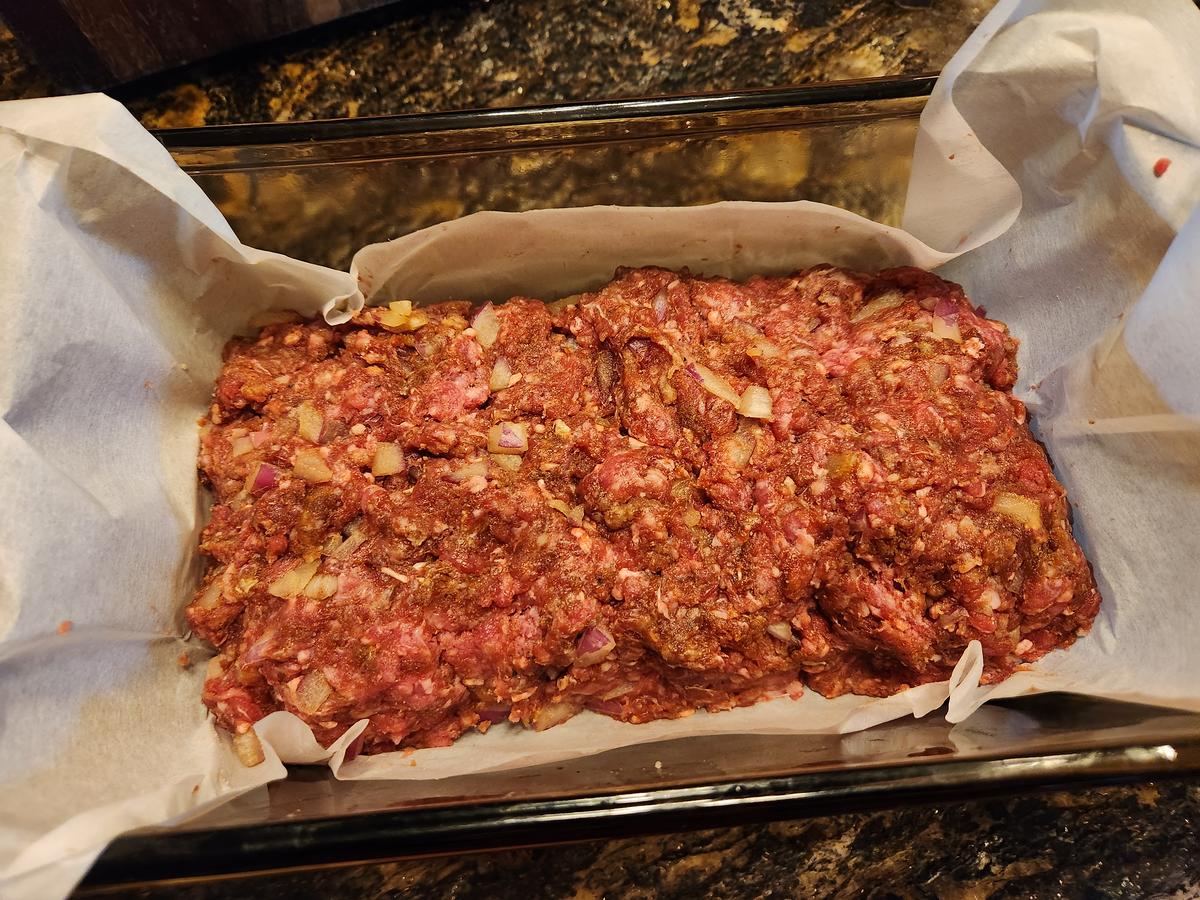
So recently, I decided to try my own version. Call it meatloaf archaeology, digging through layers of memory, trying to unearth something that might never have been written down in the first place. A little educated guessing, a little wishful thinking, a little trial and error. And this time, miracle of miracles, it came out close. Maybe not exactly Mom's I suspect that particular magic is locked in with her recipe box secrets but close enough that my younger self might've mistaken it for the real thing if I'd come home from school, backpack slung over one shoulder, baseball cap askew, looking for something to tide me over before "F Troop" came on and the world got quiet for thirty minutes.

Here's what I came up with: part memory, part hope, part love letter to Tuesday nights that felt like home:


My Almost-Mom’s Meatloaf (Baked Alaska Style)

Ingredients:

For the Meatloaf:

    • 1½ pounds ground beef
    • 1 cup quick-cooking oats
    • 1 packet au jus mix
    • 1 egg
    • ½ cup milk
    • 1 small onion, finely chopped
    • 1 tsp Worcestershire sauce
    • ¼ tsp black pepper
    • ½ tsp minced garlic
    • 1 tbsp mustard
    • ¼ cup ketchup
For the Mashed Potato Topping:
    • 4 servings mashed potatoes (homemade or instant—no judgment)
    • Optional: more ketchup

Instructions:

Preheat the Oven: Set to 350°F and lightly grease a loaf pan.

Mix the Loaf: Combine all meatloaf ingredients in a large bowl. Don’t be shy, use your hands. That’s the only way to get it right.

Shape and Bake: Press the mixture into the loaf pan and bake for 45–55 minutes, or until the center hits 160°F.

Make Your Potatoes: Whip up your mashed potatoes while the meatloaf cooks. Feel free to add chives, cheese, or a little garlic if that’s your thing.

Top and Broil: When the meatloaf is done, spread the mashed potatoes over the top. Want to go full retro? Add a thin layer of ketchup on top of that. Then broil for 3–5 minutes to get a little color and texture.

Rest and Serve: Let it rest for a few minutes before slicing.


Is it exactly like Mom's? No. The honest truth is, nothing ever will be. But it feels like it is, and maybe that's the point. Maybe the secret ingredient was never something you could measure or write down; maybe it was just the love that went into it, the hands that made it, the home that held it.

I'll keep tweaking it here and there, chasing the flavor that lives in my head and my heart. But in the meantime, this one's earned a spot in my recipe box right between "Mom's Overnight French Toast" and “Christmas Kolachky,” in the place where memory meets hope.

And who knows? Maybe someday, twenty years from now, one of my grandkids will come home hungry and remember this version just the same way I remember hers. Maybe they'll chase their own perfect meatloaf, adding their own touches, their own love, their own memories to the mix. Maybe that's how the best recipes survive not on paper, but in the hearts of people who understand that some things are worth remembering, worth recreating, worth passing on.

That's what Mom would have wanted, I think. Not perfection, but connection. Not the exact recipe, but the feeling it gave us the sense that we were loved, we were fed, we were home.