Thursday, June 28, 2012

Campus, Community, and a Career That Stuck

Editor's note: This June, I received the California Advancement Research Association's (CARA) Service Award for outstanding leadership, exceptional commitment, and dedication to CARA and my fellow colleagues.

Thank you. I’m deeply honored to receive this award, though I must admit, it feels a bit surreal. When I began my Advancement career at the University of California, Irvine, I never imagined standing here today.

At UCI, I found myself immersed in the nascent field of advancement research. Back then, our roles were still being defined, and resources were scarce. Recognizing the need for a collaborative platform, I created PRSPCT-L, one of the first listservs dedicated to the advancement profession. My vision was to create a community-driven resource, a space where peers could share insights, ask questions, and support one another. This initiative was never about personal recognition; it was about fostering collective growth.

The first SoCARA board, circa 1993 (left to right)
front row: Marsha Kraus, Laura Raymond, Cathy Terrones
back row: me, Napoleon Hendrix, Patty Tolliver

I owe immense gratitude to mentors and colleagues like Napoleon Hendrix, Cathy Terrones, Marsha Kraus, Laura Raymond, and Patty Tolliver. Their encouragement and collaboration were instrumental in bringing PRSPCT-L to life. Additionally, individuals like Karen Greene, Alan Hejnal, Michael Seymour, Shirley Gottschalk, Peter Wasemiller, and many others contributed significantly to my professional development and our community's growth.

Beyond PRSPCT-L, I was privileged to be a founding board member of the Southern California Advancement Research Association (SoCARA), the precursor to CARA. Our early meetings, often accompanied by modest refreshments and spirited discussions, laid the foundation for the robust organization we celebrate today.

But I’d be remiss if I didn’t talk about my first network, my family.

My father, for years, would ask me: “Have you gotten a real job yet?” He wasn’t being dismissive; he just couldn’t quite wrap his head around the idea that I never really left the university. From his perspective, I graduated and just kept hanging around the campus. I think he suspected I was running some sort of elaborate scam that involved free parking and campus discounts. The truth is, I didn’t expect this to become a career either. It started as just a job, a way to pay the bills while I looked for the job that I really wanted to do. But somewhere between the spreadsheets, the research rabbit holes, and the incredible people I met, it stopped being just a job. It stuck. Campus became community, and community became a calling. And before I knew it, I was in the middle of a career I never planned but wouldn’t trade for anything.

But during his retirement ceremony, he relayed a sentiment that has stayed with me. He said that careers aren’t just about balancing work and family, but about understanding how those things interact and overlap. At the time, I nodded politely, like a good son does. I was too early in my own career to have that kind of foresight. But now, looking back, I realize how right he was.

Parenting, partnering, and working aren’t separate lanes; they blur together. I’ve brought work stress home, and I’ve brought home perspective into the office. I’ve missed meetings because of school plays, and I’ve written prospect memos at the kitchen table while dinner simmered or backpacks were packed for the next day. And let me be honest, my kids have paid a price for my ambition. There were phone calls taken in parking lots instead of playing catch, donor visits scheduled over weekend soccer games, and the occasional grumble of “Are you working again?” when I pulled out my laptop on vacation.

To my children: thank you. Thank you for your patience, your rolled eyes, your hugs at the end of long days, and for being far more understanding than I often deserved. You’ve been unwitting co-authors in my career, and I hope, through it all, you’ve seen that building something meaningful, something lasting takes love, sacrifice, and a little bit of humor. Just like raising a family.

I’ve also learned that our colleagues become a kind of second family. We celebrate milestones, we share inside jokes, we vent in the break room, and we build things together like PRSPCT-L, like CARA, like careers we’re proud of. And no one, no one, receives an award like this without the strong support of both families: the one that shares your name and the one that shares your office, your values, and your mission.

So to my mentors, my colleagues, my family, both official and honorary, thank you. Thank you for making this work feel not only worthwhile but deeply human. Thank you for every brainstorm, every pep talk, every laugh, and every shared spreadsheet.

And to my dad, don’t worry. I finally got a real job. And it’s been a good one.

Tuesday, February 28, 2012

Cleats and Chaos: Finding Meaning Beyond the Scoreboard

The Best and Worst of Little League

Volunteering as a Little League coach, umpire, board member, and eventually president was one of the most meaningful and most chaotic experiences of my life. At its best, it was pure joy: being on the field, working directly with my children and their teammates, teaching the game, and watching them grow in confidence and character. At its worst, it was a front-row seat to adult egos run amok, with the scoreboard too often overshadowing the scoreboard of life lessons that really matter.

The heart of Little League is, and should always be, the kids. Coaching them was a privilege. Whether it was watching a timid player finally connect for their first hit, seeing teammates encourage one another after a tough inning, or simply enjoying the chaos and laughter of practice, those moments were the reason I signed up. There’s a unique magic in youth sports that exists far beyond wins and losses. It’s about learning, developing resilience, discovering joy in effort, and being part of something bigger than yourself.

Don't get me wrong, I wasn't a perfect coach by any stretch of the imagination. There was the time my son was pitching, and he gave up a home run and a couple of walks. I called time to pay a mound visit when my son tried to wave (or shoo) me back to the dugout; I told him to "Get your head out of your @##." We were both frustrated before I got to the mound, so my words weren't helpful (and not my best parenting or coaching moment either). In another pitching "incident," I allowed a young player to come in as a relief pitcher. He had begged me at every practice and game for weeks to allow him to pitch. I knew he wasn't ready... I sent him out to the pitching mound anyway, hoping for the best. After he walked 6 batters in a row (without throwing a single strike), I went to the mound and relegated him to right field... In hindsight, I wish I had worked with him more so he would have been better prepared (and that I hadn't caved to his request).

Looking back, I know I wasn’t immune to poor judgment or pressure. But those moments, embarrassing as they were, taught me that humility and growth are far more important than winning any game. But all too often, that lesson gets drowned out by the noise from the sidelines.

As president of our league, I faced the unfortunate reality that some adults put their own egos ahead of the kids. I dealt with parents trying to relive their own athletic glory through their children, pushing too hard, criticizing too loudly, and forgetting that this game was supposed to be fun. I witnessed others attempting to bend or break the rules just to gain an edge on the scoreboard, as if youth baseball was a stepping stone to some professional dream rather than a stage for growth and camaraderie.

Some used their roles as volunteers or administrators to secure advantages for their child’s team, engaging in subtle manipulations that eroded trust and undermined the spirit of fair play. That was the most disheartening part of leading the league: managing the politics and misplaced priorities of adults who had forgotten that youth sports are not about them.


Our "competitive Tee Ball" division was one of those areas where there were already problems. What was intended to be a lighthearted, developmental experience for five-, six-, and seven-year-olds had become a proving ground for adults who had lost sight of the purpose of youth sports. Parents shouted at umpires over calls that didn't matter. Coaches argued with each other, lobbied to stack teams with older, stronger players, and instructed their players to run fundamentally unsound plays to exploit loopholes in Byzantine rules. The joy and discovery that should define tee ball were often replaced by pressure, frustration, and confusion for the children on the field.

Rather than addressing the root causes of the dysfunction, unchecked competitiveness, and misplaced priorities, league administrators leaned into the problem. They formalized standings, hosted all-star games, and implemented a playoff bracket for six-year-olds. These rules weren’t built to foster teamwork, teach fundamentals, or help kids fall in love with the game. They were crafted to validate adult egos. The result was a structure that encouraged adults to treat a child's first exposure to baseball as if it were the Little League World Series. In trying to legitimize their own competitiveness, the adults inadvertently undermined the very growth and joy the league was meant to nurture.

And as any adult who has participated in youth sports knows, these problems don't just go away as the kids progress. The kids get older and move up levels... and their parents come with them, bringing all the bad habits and animosities they learned at the previous levels.

I was lucky that we moved into this league after my son was too old for Tee Ball. He played in a developmental league when he was five years old, Tee Ball in the first half of the season, and "coach pitch" in the second. When he moved up a level at seven years old, it was coach pitch the first half of the season and "kid pitch" the second. By the time he was eight and nine years old, he was ready to compete with kids his own age, and we were doubly lucky that he mainly played on teams with good coaches and managers (me notwithstanding).

So, when I became president of the league, once my son started middle school, I truly wasn't ready for the craziness to come. I thought stepping into a leadership role would mean organizing schedules, ordering uniforms, and maybe handing out trophies at the end of the season. Instead, I often found myself less like a league president and more like a crisis manager for adults. Week after week, I mediated shouting matches between coaches, issued warnings to parents berating umpires, and fielded emergency calls over sideline confrontations that escalated far beyond what any Saturday youth game should entail.

When I moved from the dugout to the boardroom, the stakes changed. Suddenly, I wasn’t just a coach trying to help a group of kids; I was the one responsible for keeping the league itself from unraveling.

Some of the biggest challenges came from coaches who embodied a “win at all costs” mentality. These weren’t just competitive people; they were adults who treated every youth game like Game 7 of the World Series. They ran up scores, manipulated lineups, and bent rules not for the kids, but for the scoreboard. And while I’ll be the first to admit I love winning and hate losing, that mindset robs the kids of something essential. 

The most surreal part was dealing with parents of 10-year-olds, convinced that their child’s future athletic scholarship was on the line because their child only played three innings instead of four. These weren't one-off concerns; they came bundled in long emails, accusations of favoritism, and ultimatums about pulling kids from the league. And the coaches? Some couldn’t even pretend to get along, letting old grudges play out through passive-aggressive lineup decisions or loud confrontations in front of the kids. It stopped being about teaching the game and started to feel like a proxy war for adult egos. What should have been a community effort to build confidence and camaraderie in children too often became a theater of insecurity and misplaced ambition.

CVLL President Joseph Boeke, presenting the 2011 Grace Chase Sportsmanship Award to Jason Crosthwaite.
Still, for all the drama, there were moments that reminded me why I stayed. Opening Day was always a favorite: kids in fresh uniforms buzzing with excitement, running the bases in skills competitions, their parents actually cheering (instead of complaining), and everyone enjoying the simple thrill of baseball. I loved the closing ceremonies too: awards, all-star announcements, and the sense that, despite everything, we’d created something meaningful.

And I kept coaching. I kept showing up for practices and games, especially when my daughter was on the field. Every time I laced up my cleats and walked onto the diamond, the noise of the adult world faded just a little. There was something grounding in helping a kid make their first catch or watching a team cheer each other on after a tough inning.

I remember sitting near the dugout during one of my daughter’s games, listening to the girls chant and rhyme while their team was up to bat. That dugout energy was pure magic, supportive, silly, loud, and full of joy. One of their cheers stuck with me:

Do it again, we liked it, we liked it. 

Do it again, We liked it, We liked it.

Faith playing softball for her Kiwanis Club team in 2011.
It was a reminder that these kids understood something many adults seemed to forget: the value of simply showing up for each other. The girls had the most fun when they stopped making it about themselves and focused on their teammates, win or lose.

Youth sports are supposed to be where kids learn teamwork, resilience, and sportsmanship, not where they become pawns in an adult’s quest for validation. When the focus shifts from development to domination, the kids lose more than a game; they lose a chance to discover joy, teamwork, and the quiet confidence that comes from simply being allowed to grow.

Don’t get me wrong, I value many of the adult friendships I made during my time in the league, even the complicated ones. By the time my son reached his freshman year of high school baseball, I had only managed to see him play two or three times. Running the league had slowly replaced watching my own son play the game we both loved. Mediating adult conflicts became work. Watching kids play was joy. So I stepped away, not from baseball, but from the chaos, and returned to my favorite title: Dad. Not a dad trying to outcoach or outmaneuver other dads. Just a dad in the stands, cheering his kids on.

In the end, what Little League gave me wasn't just a front-row seat to my children's growth; it gave me a deeper understanding of my own. It reminded me that youth sports aren't about crafting champions; they’re about building character. They're not about polishing résumés for future scholarships; they're about teaching kids how to fail, try again, and love the game anyway. And maybe, if we’re lucky, they teach us grown-ups a little something too about humility, patience, and the importance of knowing when to step back and let the kids lead the way. What mattered most wasn’t the final scores or standings. It was watching my kids, and so many others, learn how to stand tall after a strikeout, celebrate a teammate’s success, and fall in love with a game that gives far more than it ever takes. That’s the meaning I found beyond the scoreboard. And that’s what I’ll carry with me long after the chaos has faded.


Saturday, July 23, 2011

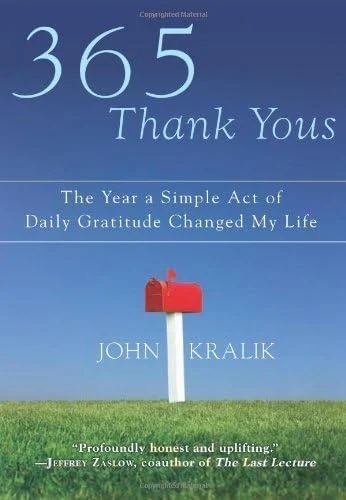
365 Thank Yous (REVIEW)

365 Thank Yous: The Year a Simple Act of Daily Gratitude Changed My Life

365 Thank Yous: The Year a Simple Act of Daily Gratitude Changed My Life
by John Kralik

My rating: 3½ of 5 stars

I first looked at this book in a college bookstore. It was on a shelf filled with books for graduates and students entering college. At first, I thought that perhaps it was a little out of place, immediately thinking it was a typical self-help book. I didn't buy the book then, but when I ran across it again at my local bookstore, I decided to pick it up based on the cover recommendation by The Last Lecture co-author Jeffrey Zaslow (whose NY Times column I frequently read).

Kralik's book is an accessible and easy read, and I was happy to find that it isn't really a self-help book at all; rather it is a personal memoir of a particular year or so in his life. It isn't great literature, nor is it a "step-by-step" guide to picking yourself up by the bootstraps—a Wayne Dyer-esque type book. 365 Thank Yous isn't really pop psychology, nor is it preachy... The crux of the book is Kralik's desire to try and look at his life through a different lens. Rather than continuing to be bitter and angst-ridden over all the problems in his life, Kralik sought to try and find things to be thankful for and to do so every day for a year.

As he goes through his thank you letter exercise, not only is Kralik able to gain a new (and better) perspective on his own life, he starts to equate the turn-around in his fortunes, as evidenced by some of the good things happening in his life, to his thank you letter writing campaign. Which not only reinforced his mission but recalled his earliest experience writing a thank you note to his grandfather:

He promised that if I wrote him a letter thanking him for this silver dollar, he would send another one. That was the way thank-you letters work, he told me.

I think that one of the reasons this book struck a chord with me is that I can recall being "chained" (figuratively, not literally) to my desk after my high school graduation, writing thank-you notes to all the people who sent me gifts. At the time, it was the last thing I wanted to do, but I remember my mother explaining that not only was it the right thing to do, but that good things would follow as a result...

As I read through the book, I found myself drawn closer and closer to Kralik's narrative. Initially, this had as much to do with our lives seeming eerily parallel. To begin with, we worked in the same part of town (at the same time he was going through his letter-writing campaign), and I've been to almost every place that he mentions in the book (in fact, we could have easily bumped into each other at any one of several local places). Our careers briefly intertwined when we worked for the same company in the early 1990s...

But most importantly, I can relate to how Kralik perceived himself in 2008. Like him, I had been through the divorce ringer; I wasn't happy with how my career was progressing and wasn't fulfilled by my work. On top of that, my personal relationships were at an all-time nadir.

Kralik's solution to these "problems" was to look for things to be thankful for (and to write his thank you notes). This is certainly a "therapy 101" solution to these kinds of challenges and isn't (or at least shouldn't be) an earth-shattering epiphany for most people. But for me, at least, reading Kralik's memoir has allowed me to look at my own life and consider all of the things in my life for which I am grateful, and if I choose to write a few more thank you notes as a result... then all the better.

View all my reviews

Monday, May 30, 2011

Memorial Day

In a 2008 blog post, I wrote that it has become passé to remember Thomas Jefferson's admonition that "Liberty needs to be watered regularly with the blood of tyrants and patriots." Almost three years on from that scribble, our collective memory seems to be fading more markedly than I first thought.

Today the immortal words of Winston Churchill ring more true than ever: "never was so much owed by so many to so few". The rights and freedoms that we enjoy are hard earned privileges, not entitlements. As Jon Meacham of WNET points out in this PBS Need to Know essay, the separation between most American citizens and those who serve (and pay) to protect our nation has widened almost to the point of non-recognition:

This Memorial Day takes place not even a month removed from the killing of the "most wanted man in the world", the face of the "global war on terrorism", Osama bin Laden. Yet Americans are decidedly removed from a sense of urgency in our current conflicts in Iraq, Afghanistan, and Libya, let alone remembering the sacrifices of years gone by. Collectively, we seem to have forgotten the simple act of remembering the cost, in human lives, that has been paid to ensure that we have the freedom to enjoy three-day weekends, to eat hamburgers and hot dogs, and share the company of our friends and loved ones on this holiday weekend.

In his General Order #11, marking the first Memorial Day on May 30, 1868, General John A. Logan wrote:

Let no vandalism of avarice or neglect, no ravages of time, testify to the present or to the coming generations that we have forgotten, as a people, the cost of free and undivided republic.

If other eyes grow dull and other hands slack, and other hearts cold in the solemn trust, ours shall keep it well as long as the light and warmth of life remain in us.

Logan's words are prescient. At the sesquicentennial of the Civil War, there are no longer living veterans who remember the sacrifices of their comrades. America's last World War I veteran passed away in February 2011, and World War II veterans are passing at a rate of 1,000 vets per day.

Remembering—not just on the last Monday in May, but in the quiet, ordinary moments. I’ll remember when I see someone else stepping up to serve, or when I pass by a memorial that too many people don’t notice anymore, I'll remember when I speak my mind and disagree openly and without fear. It doesn’t have to be some grand gesture. Sometimes it’s just taking a beat to acknowledge that what we have didn’t come easy—and that someone else paid a price so we wouldn’t have to.

Memorial Day 2011 by thrunance'seyes
Without those who saw these sacrifices first-hand, it is up to each of us to put into practice General Logan's words.

Today, I choose to remember the sacrifices of the men and women, some of them my friends, who gave themselves for something we are allowed to take for granted. That feels like the least I can do. 

Saturday, April 9, 2011

One Year - In Memory of Bill Peters

A year ago today, Bill Peters passed away.

I have thought about that sentence a hundred times since last spring, trying to find a way to write it that does justice to what the man meant to this community and to me. There is no such way. So I will start simply and work from there.

Bill was 72 years old and had spent nearly four decades at Crescenta Valley Little League, first because his son Matt played tee ball in 1971, then because his son Greg played, and then because he could not stop. The league became part of who he was. When I first joined the CVLL board, Bill was already the institutional memory, the keeper of the records, the person whose phone you called when you did not know the answer and did not want to guess. He had spent years at JPL helping to put Surveyor, Voyager, and Mariner into the sky, and he brought that same precision to keeping score on a folding chair at Montrose Park.

He was the one who put together the Rally Tally.

If you were a player in this league during those years, you remember it. Bill assembled the Rally Tally every week — a detailed account of every team, every game, every hit, every run, every player who did something worth noting. Families waited for it. Kids who tore past it on the way to the field would double back when they thought no one was watching, just to see if their name was in print. Bill knew that. He was counting on it. What he never did was use it to criticize a player. Not once. He knew these were children trying their best, and he refused to discourage even one of them. That was not an oversight. It was a decision he made every single week.

He also kept something else: the long record of players who had been part of CVLL every year of their Little League careers, from tee ball through Majors and Juniors. He tracked them quietly, the way he did most things, because he believed that kind of loyalty deserved to be recognized. After Bill died, the league named its legacy award in his honor. It goes each year to the players who stayed the full distance. His name is called at closing ceremonies now, and it will be called for as long as the league runs.

Shortly after Bill's passing, CVLL nominated him for the Glendale Unified School District's Character and Ethics Award. His widow, Collette, and their children accepted it on his behalf. I was glad we did it, though the timing felt backward, that a man this decent needed a formal committee to recognize what anyone who sat next to him at a game already knew.

When I was elected president of CVLL, the election was not without friction. The politics of a youth baseball league can be surprisingly fierce, and I stepped into the role with some opposition still simmering. I was underprepared. I knew the game. I did not fully know the job. Bill steadied me. He answered the questions I was embarrassed to ask publicly. He sent quick emails when something needed doing and made sure it got done, usually by doing it himself. He helped me understand not just the rules and the history but the spirit the league was built on. He was in his seventies and had no obligation to do any of it.

I have had mentors in my life, but they tend to show up in professional settings with formal titles attached. Bill was nothing like that. He was the league dad, not managing me, not reporting to me, just showing up, knowing more than I did, and making sure I did not embarrass myself or the kids in my care. When something needed doing, and I did not know how, he already had the answer. When the pressure of that first year threatened to get ahead of me, he had a way of making the next right step obvious without making me feel small for not seeing it. I thought about my own father often during those months. The steadiness was the same.

This spring, I have been doing Bill's work. Some of it I knew he did. More of it I am discovering only now. The program book. The website. The follow-up calls. The things that hold together when someone tends them and fall apart the moment they stop. It has not been easy, and there are moments when I reach for the phone to call him, only to catch myself.

My son Ted was a freshman at Crescenta Valley High School last year. Bill knew what my commitment to the league presidency was costing me. He encouraged me to get to Ted's games, and when I could not, he understood, but he also made clear he thought I was missing something I could not get back. After Bill died, I felt the need to fill the gaps he left behind, and they were considerable. I missed almost all of Ted's freshman season. This past year, with Ted a sophomore, I made a conscious decision to pull back and let other parents and families carry the league forward. I saw more games. I am glad I did. Bill would have told me to do it sooner.

He used to keep score at games long after his sons were finished playing. He would sit in the stands with his scorecard and his pencil and follow the game the way a person follows something they love, closely and without agenda. I sat next to him a few times in my first year on the board, and those were the best conversations I had that season. We talked about the kids on the field and about the kids who had played years before. He remembered them all. Not the statistics. The kids.

Bill gave his time to something long after anyone expected him to. He made himself useful without being asked. He understood that the details  the Rally Tally, the program book, the long list of kids who never missed a year  were how you showed people they mattered. This community was shaped by him, and the debt does not diminish with time.

I miss him every week.

Thursday, March 3, 2011

Hustle Ball

Baseball Back when I was a kid, baseball practice was boring (for the most part). Two hours of waiting for a turn to do something. We'd start by warming up our arms, but that was pretty much it. Then we'd take positions assigned by the coach, and he'd hit balls to us to simulate situations, runners at first and third, etc. After 45 minutes to an hour of this, we’d start some kind of batting practice. One or two players would come in off the field: one to hit, one to wait. Then rotate outfield to the dugout, and so on.

I can still, three decades later, remember waiting all of practice just for the opportunity to hit. The rest of the practice was just waiting, punctuated by the occasional field or throw. Even when I played catcher and touched the ball more often, it remained a rather dull experience. And for the rest of the team, 8 or so kids were doing almost nothing for two hours. A wasted opportunity to build skills.

So, when I coach, I take a more methodical approach with rotating skill stations. But stations require supervision not just for safety, but to ensure proper instruction. Repetition only helps if the technique is right. The problem is: many youth coaches lack the help they need to make this happen, despite having solid practice plans (which I highly recommend writing out in advance).

For those coaches with limited help, here’s a suggestion: most youth teams have 12 players; divide them into three squads of four. Then enlist three parent volunteers to help supervise. This breakdown makes practices more efficient and keeps kids engaged. With small groups, you can provide quick instruction, then let the kids work with one another or a volunteer to run the drill, allowing you to circulate and give guidance.

Uneven groups aren’t ideal, but manageable. Just aim to reduce downtime.

Squads also foster competition players strive to set or beat records. Most kids love to compete, and it helps you assess their progress quickly.

To wrap up practice, we play a fast-paced game called Hustle Ball. The key is hustle (not just speed). Once learned, we can run a six-inning game in 30 minutes or less.

Equipment Shortstop Throwing

  • 4 Ball Buckets
  • 1 L-Screen
  • 1 Stopwatch
  • 2 Coaches

Setup is pretty easy, empty 3 ball buckets into one, then place an empty ball bucket in foul territory behind first base, another behind second base, and one next to the catcher.

Place the full bucket of baseballs behind the L-Screen for a coach to throw. One coach will be the pitcher for both teams, and one will keep time on the stopwatch.

Rules

  • Standard baseball rules apply, with these adjustments:
  • Start with generous time between pitches and innings (work toward 10 sec/pitch, 30 sec/inning).
  • Hitters start with a 2-1 count.
  • Catcher places balls in the bucket beside him, not thrown back.
  • After a play, defense has 10 seconds to bucket the ball; offense has 10 to send in the next hitter.
  • Countdown begins at 5 seconds: “5-4-3-2-1,” then the pitch is thrown.
  • Fielders bucket balls after plays, no returns to the pitcher.
  • After the third out, 2B/SS bring their bucket to the mound and refill the coach’s bucket.
  • Incoming fielders reverse the process. Failing this = automatic out.

Teams have 30 seconds between innings. If the first batter isn’t ready, helmet on, in the box when time’s up, a pitch is thrown and counts as a strike. Same for unready defense: the pitch is live.

To emphasize hustle, call outs if bats or helmets are left near the field, or players walk instead of sprinting on/off the field. My players keep helmets on when fielding to simplify transitions.

Try this approach. After 60–90 minutes of drills, players enjoy actually playing. And they’ll be excited for the next practice.